Day 11 – Dawson City

Close to 100,000 prospectors set off over the Chilkoot Trail in Dyea/Skagway, Alaska on foot then sailed up the Yukon River to find their wealth in the gold fields surrounding Dawson City, Yukon. With a population of only about 1,900 residents this National Historic Site and UNESCO nominated town has many restored buildings and sites to explore. A few of the places to explore and enjoy a trip back in time are a walking Tour of town, the Palace Grand Theater, the Jack London Museum, Diamond Tooth Gertie’s to join the Sourtoe Cocktail Club by having a shot with an actual toe in it at the Sourdough Saloon in the Downtown Hotel (the toe must touch your lips), see the SS Keno the last steamer to run the Yukon River, discover the areas history at the Dawson City Museum and just outside of town explore the grand old Dredge #4, Discovery Claim National Historic Site and the steamship graveyard.

7-31-17

First up for a bit of vehicle maintenance, the vehicles needed a complete cleaning with all the mud buildup from the drive yesterday. It took about 30 minutes each to get most of the dirt removed from the outside.

After the cleanup it was over to Dredge #4 to investigate. A guided tour is available to explore the inside of the dredge. An interesting informative tour is provided but it is not inexpensive, although I felt well worth the cost.

7-31-1

Dredge No. 4 mined gold from 1913 to 1959. This wooden-hulled bucketline sluce dredge  is now located along Bonanza Creek Road about 8 miles (13 k) south of Dawson City along Upper Bonanza Creek road. This the largest wooden-hulled dredge in North America was designated a National Historic Site on 22 September 1997.

Designed by the Marion Steam Shovel Company it was hauled in pieces to Dawson City at a cost of $134,800 for shipping which was then built by the Canadian Klondike Mining Company on site at Claim 112 near Ogilvie Bridge, the current location of the bridge over the river along the Klondike Highway to Dawson City. It moved to its current location along Bonanza Creek by digging a path and filling in the area behind itself in its own pond.

Excavating gravel at 22 buckets per minute with 72 large buckets that processed 18,000 cubic yards (14,000 m3) of material per day. In use from late April or early May until late November each year, and sometimes throughout winter, it captured nine tons of gold during its operation.

Continuing along the dirt road we made a stop at the Discovery Claim National Historic Site where gold was first discovered in the area for a short walk around the displays explaining the mining operations of the area.

Stopping by a small tourist stop with a souvenir shop, old buildings and quite a lot of old mining equipment I explored the old buildings and equipment having a fun time with my camera.

Back in town I dropped the car off at the hotel and wandered the rest of the afternoon and evening around the streets, shops and museums of Dawson City. First up was the Dawson City Visitors Center to look around the exhibits and get an idea for a much needed very late lunch. Leaving there with several ideas I strolled across the street to the NWT Dempster Highway Visitor Center to see what was missed during the previous few days. This would be a good stop if you are going up the Highway after your visit here in Dawson City.

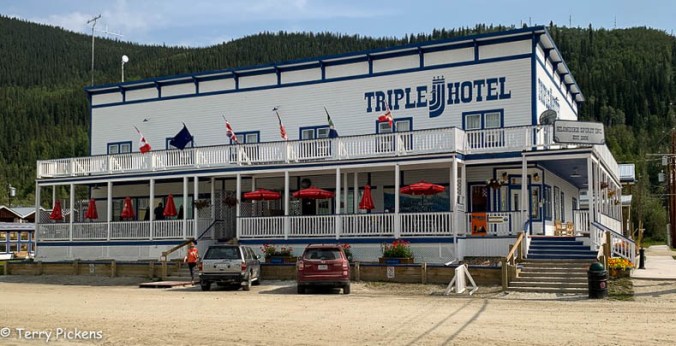
After talking to the very nice informative person working there I continue my wandering to the Triple J Hotel and restaurant for my late lunch. I had the tasty Wild Salmon Burger with a caper aioli and an iced tea. Sitting on the outside porch I enjoyed my meal watching the activity happening on the street it was a very good relaxing meal.
7-31-44

I sat on the porch on the left for lunch. What a wonderful place to have lunch.

After lunch I continue on to the Dawson City Museum where I explore the exhibits on 2 floors of the old Territorial Administration Building discovering the natural history of the Klondike Gold Fields through exhibits, displays, dioramas and informative shows. You explore the history of Yukon’s First Peoples and early explorers. Experience the Gold Rush through the stampeders and entrepreneurs, and the visionaries. I was fortunate enough to see a live demonstration of a sluce shaker box in action and how gold was recovered from the river and stream beds.

7-31-45

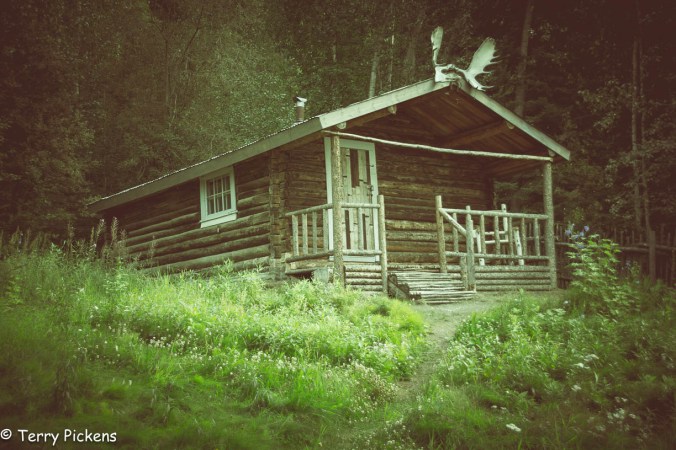
Walking to the outskirts of town I visit the Robert Service Cabin. Service was a British born poet referred to as the “the Bard of the Yukon”. He was one of the most successful poets of the Twentieth Century. who arrived in the Yukon as a bank clerk turning vivid tales, told to him by veterans of the great gold rush, into classic poems. Robert Service arrived in Dawson City in 1908 continuing  to write about his northern adventures until his departure from Dawson, and the Yukon, in 1912. Sadly the cabin was closed for the day so I couldn’t get a glimpse inside to see how this gentleman lived.
7-31-19

Just down the street was Jack London Museum and Cabin. This museum and cabin shows the time Jack London spent a year in the Klondike. Trying his hand at mining he still spent most of his time writing stories that would make him a well known author. It again was closed due to the late time I had passed there.

Just west is a pedestrian-bicycle trail along the Klondike and Yukon rivers that I followed back to my tent cabin  for the evening. Stopping at the store for a few items I continue to the cabin to shower, due some laundry and relax for the evening. Another travel day in the morning so must rest up.

It was amazing that just before the grocery store I noticed a large European based adventure RV turning into a parking lot. I had to get a closer look and hopefully talk to its drivers. I met a wonderful couple, he from Luxembourg, a small European country surrounded by Belgium, France and Germany and his wife from France. I talked with them for about an hour listening to their adventure so far and where they are going on their long trip.

As a side note, they stopped by my house when I returned from the adventure for dinner and the stayed the night on their trek to Mexico and Central America. I wish them well on their journey.
The Northern Adventure – Journey to the Yukon

Having already started the first post of this adventure HERE although I should explain what this Journey is about and where in shall go. 

But First:

ADVENTURE – An exciting, daring, bold, risky or very unusual experience or undertaking fraught with physical, financial or psychological risks.

Lets go on an Adventure

What does this mean? It can be different for everyone; skydiving, mountain climbing, scuba diving, river rafting, caving (spelunking) traveling, exploring…… anything that is outside the ordinary for that individual is an adventure. Many make their adventures a way of life and never stop. For some it is just a day, weekend or short trip. Does it need to involve speed, height, a high level of physical exertion or highly specialized gear, some would say yes. I do not think that at all, it is up to the individual the extent of the adventure to be accomplished.

The Individuals:

The explores will consist of 2 individuals who are basically strangers, we came together on social media in our interests for the outside and vehicle exploration. Communicating through the computer is all we done as we live in different states. The team consists of Heather’s 2015 Subaru Outback (#heidi_roo), and myself in a 2017 Subaru Outback (#sled_rider).


The Journey:

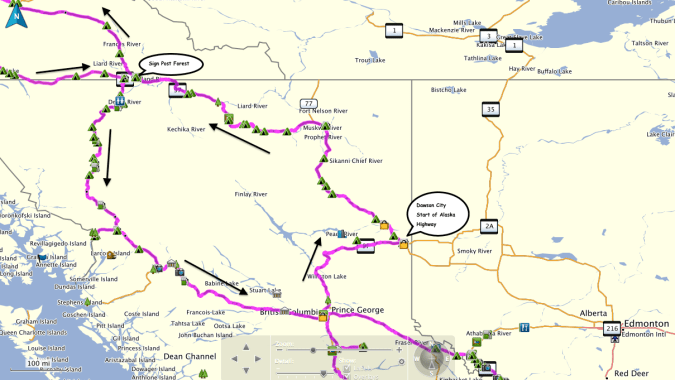
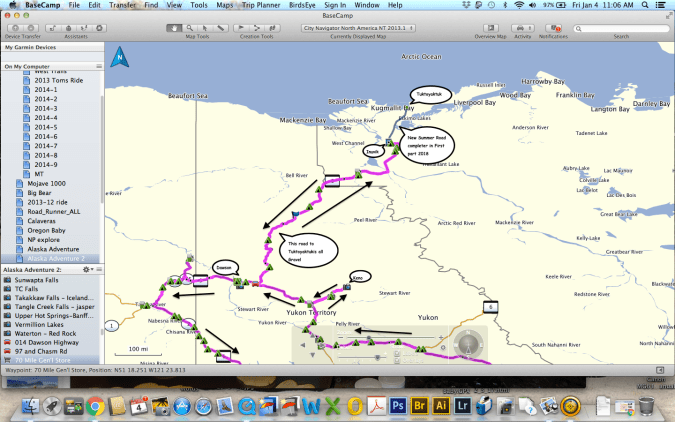
It will involve a drive from Vancouver, WA to Dawson City, Yukon Territories, Canada, up the Dawson highway to the Arctic Ocean at Tuktoyaktuk, YT, Canada and back. It is something I have never done and it has always been on my bucket list. I have taken 2 cruises to Alaska and have loved the experiences. I now want to experience the lands of Canada and Alaska from the ground driving through the countryside.

Map 1Map 2Map 3Map 4

  • Will it be an adventure? …..yes as this will go far north as you can drive in Canada.
  • Will it be exhilarating? …..Yes.
  • Will it be fun and exciting? …..Definitely.
  • Is this outside the box for travels…..Definitely.
  • Am I excited to plan and start this adventure? …..OH YES.
  • Has this route been carved in stone…..NO, it will change even as we travel I’m sure.

The trip will leave Vancouver, WA and head up Interstate 5 to the Canadian Border. Crossing into British Columbia, Canada the journey continues north to Prince George, BC and to the start of the Alaskan Highway in Dawson Creek, B.C., Canada. British Columbia has a population of approximately 4,751, 600 in 364,764 sq. miles (944,735 sq. km) making it the 3rd largest province in Canada.

Heading north from Dawson Creek we will go along The Alaskan Highway, Canada Highway 97, passing through Fort Nelson and entering the Yukon Territories, Canada just before Watson Lake to visit the Sign Forest. The Yukon has the smallest population of any Province/Territory of Canada at approximately 37,858 with a land area of 186,661 sq. miles (483,450 sq. km).

What is the difference between a Province and Territory? Territories are administrated differently than Provinces. Provincial government powers are laid out in the Constitution, whereas the territories are given powers from the federal government, thus the territories control less of their own affairs.

Heading north on The Campbell Highway, Canada 4 we will stop in the old mining town of Mayo / Keno then will then make our way up the Dempster Highway, Canada 5, crossing the Arctic Circle, Inuvik, Northwest Territories, Canada and then continue the final 130 km on the new all season road to Tuktoyaktuk, Northwest Territories, Canada and the Arctic Ocean. The Northwest Territories has an approximate population of 44,469 that live in an area of 452,480 sq. miles (1,171,918 sq. km), this province has about the one sixth of the land area of Canada making it the second largest and most populous territory of Canada.

I mention the population and sizes of these Territories as they are still sparsely populated; a majority of Canadians live very close to the border with the United States. The population for the state of California is estimated to be 39,497,000 in 2017 with an area of 163,696 sq. miles (423,970 sq. km). The state of Washington has approximately a population of 7,535,591 and a land area of 71,362 sq. mi (184,827 sq. km). When you look at these numbers California has 241 people per sq. mile (93 people per sq. km), Washington has 106 people per sq. mile (40 people per sq. km), while The Yukon with 6.5 people per sq. mile (1 per sq. km) and The Northwest Territories having 1 person per sq. mile (about 1 person per 2 sq. km). So as you can see the farther north we head the less people, cities and urbanization will be encounter.

SOUNDS LIKE A GOOD PLAN.

After dipping our feet into the Arctic Ocean and exploring the area it will be time to return to Dawson City, Yukon Territories, Canada to explore the old mining district and town. The journey will then cross the Yukon River on a ferry as we head west to Chicken, Alaska along Top of the World Highway. Continuing on the Taylor Highway to the junction with the Alaskan Highway, we turn south for Haines, AK along the beautiful Haines Highway.

Backtracking to the Alaska Highway the route passes through the Capitol of the Yukon Territories, Whitehorse, the only city in the Yukon Territory. Leaving Whitehorse we will head toward the Cassiar Highway, Canada 37, and back to Prince George. From Prince George it is east to Jasper, Alberta, Canada to visit Jasper National Park and Banff National Park along the Icefields Parkway to Banff, Alberta, Canada.

From Banff we will enter back in to the continental United States and journey along the Going-to-the Sun Highway in Glacier National Park. After a short stay in Glacier NP it is time for all to return to our home bases.

·      Adventure? …..I think so.

·      Something out of my ordinary routine? …..DEFINITELY for me.

So what does this involve? A lot of investigation on the Internet, reviewing maps and with the help from individuals who kindly share their knowledge of the areas that are being visited. I will be camping along the way when possible and staying at motels, hotels or lodges only as needed to freshen up.

·      Will schedules change?

·      Will additional sites present themselves?

·      Will destinations be revised?

All a YES to me, it is still being planned so anything is all possible.

Since we will be camping most of the nights along the journey. Some of the camping equipment in my vehicle will include Roof Top Tent, sleeping bag, stove, pots, fry pan, plates, cooking and eating utensils, camp chair and table, mosquito repellant and head netting, camp lights and batteries, propane, lighter and matches, trash bags, cleaning bucket, 5 gallon drinking water container, a refrigerated cooler and food storage containers, a hand held GPS, first aid kit, whistle, cordage (para-cord), knife, bear spray, maps, compass and Garmin In-Reach Satellite Emergency System . Communication between vehicles will be with HAM, GSMR and Citizen Band (CB) radios. We will have at least one complete set of tools and vehicle recovery gear for any unforeseen issues with mine having a winch permanently installed.

This should be a great Journey.