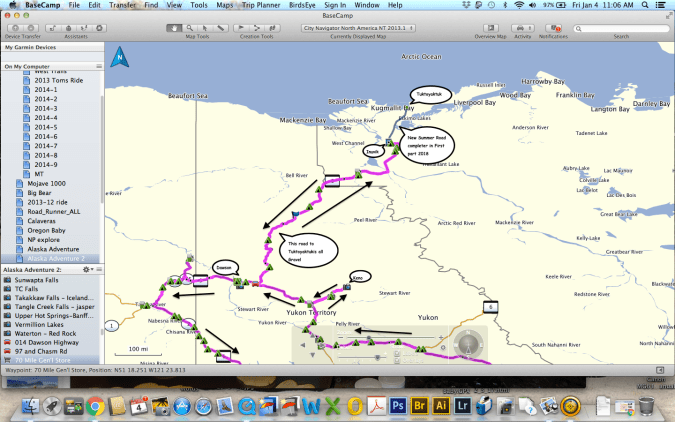
Day 5 – Into the Yukon Territories

Leaving the Northern Rockies Lodge we continuing traveling on the Alaska Highway heading toward the Yukon Territory.


Lower Liard Bridge built in 1943 is a 1,143-foot (348 m) long suspension bridge is the last remaining suspension bridge along the Highway.

Liard River Hot Springs Provincial Park is a day use area with some camping. A short hike leads back into the Hot Springs Pool and has been a favorite stop along the highway to soak away those long days of driving. Passing through Liard River Hot Springs there are buffalo all over the road. It was like I was transported to Yellowstone National Park where I was stuck in a Buffalo traffic jamb. The buffalo here stuck to the shoulder of the road not creating a problem for traffic.


The Alaska Highway travels east and west for a portion of the route today so you pass into and back out of the Yukon Territory for a few miles until you enter it for good about the 7.5 miles (12 k) before the town of Watson Lake.


Next stop was Watson Lake, a town 612 miles (980 km) along the Alaska Highway is best known for the few acres of the offbeat at the Sign Post Forest. Designated in 2013 as a Yukon Historic Site, was started by Carl Lindley by adding a sign at this location pointing to his hometown with the mileage. Other G.I.’s added more signs to the post for their hometowns. started this collection of signs and license plates from all over the world during the construction of the AL-CAN. Numbering about over 80,000 signs travelers are still adding to this collection. Right behind is the Alaska Highway Interpretive Center, which has a video on Yukon history with photos and displays of the construction of the AL-CAN. This was town was important during the construction due to the airport and being one of the major refueling stops of the Northwest Staging Route.


Turning north along Canada Highway 4, The Campbell Highway, a 362-mile (5983 km) paved but mostly gravel road will lead to Highway 2.


Named after the first white man to explore the Yukon area, John Campbell, this all season road leads from Watson Lake to just north of Carmacks on Klondike Highway (2). This rougher road is shorter in mileage than continuing along to the junction of the Alaskan Highway and the Klondike Highway but it is much slower. Services are few and far between along this highway.

At Ross River, a supply and communications base for prospectors in the area that is now a jumping off point for hunters and canoeists, it was decided to stopper the evening at Lapie River Campground. Setting ups camp we took the short walk down too the river to enjoy the sounds.


Day 4 – Onward to Fort Nelson and Beyond

Waking up the next morning there was a light rain dropping on the tent. Packing up quickly and having a quick breakfast we cross the Kiskatinaw Bridge and link back up with the Alaska Highway a little further north from where we left it last night.

Here are some sights that are located along the drive today. Medium to heavy rain meant we continued on praying that it would stop for the evening camping.

H. Maclean Rotary RV Park at Charlie Lake has a memorial for 12 soldiers that drowned in May of 1942 when their pontoon boat sank transporting equipment to the job site on the opposite bank of the river.

The treacherous Suicide Hill was a grade that welcomed travelers with a signpost reading “PREPARE TO MEET THY MAKER”. Guess you had to have a sense of humor if you were traveling up here in the early years. The Highway now bypasses this hill.

330ed5e06ffb22bde3e0e74dc0f2d42b--us-army-soldier-alaska-highway

Suicide Hill

Sikanni Chief River Bridge was the first permanent structure completed along the highway. Built by African American army engineers it was destroyed by an arson fire in 1992. Only the original pilings are remaining.

The southern end of the Trutch Mountain Bypass is at Historic Milepost 191. This section of the Highway was bypassed in 1987 with a new road eliminating a steep mountainous winding drive. The original roadbed is a gravel road still in use by gas and oil patch crews.

Fort Nelson 283 miles (454.3 km) north of Dawson Creek is another town offering lodging, services, campgrounds and a few attractions. Originally based on the fur trade, the town was built in 1865 along the Fort Nelson River’s west bank after the second town was destroyed by fire after the local aboriginals killed the 8 inhabitants in 1813. A upward growing population in the 1940’s and 1950’s got the town recognized as an Improvement District in 1957 and finally a village status in 1987. Mile zero to clearing crews of the AL-CAN, this town is where the first clearing crews started work along the AL-CAN as a winter road already existed between Dawson Creek and Fort Nelson.

Arriving in Fort Nelson it was still raining pretty good so went into the Visitor Center for a break from the drive and to discuss the plans for the night. This is a very nice Visitor Center with a great information desk, a souvenir shop, visitor information brochures, a short movie on the area and a large sitting area for resting. Going onto WiFi it was shown by weather apps that the rain will not subside anytime soon and is scheduled to be pretty heavy at times.

Searching the road ahead it was determined to try and get a place to stay along Muncho Lake at The Northern Rockies Lodge. This is a nice lodge but a little expensive. Oh well, this might be the last time for a room and shower for awhile and the rain was coming down pretty good.

Asking the information desk on a nice place to have a late lunch it was recommended to try a restaurant just down the street. The Gourmet Girl is a small establishment that serves very good food in a quaint atmosphere.

Veering west for 200 miles (322 km) the Highway enters a dense forested area with distant wilderness vistas of 100 miles (161 km) or more.

Gardner Creek is named for local trapper Archie Gardner who helped recon this part of the AL-CAN. He is remembered in Earl Browns book “Alcan Trailblazers” by Harry Spiegal as “An old trapper….who has lived up here all his life, is the wrangler and is in charge of the string. He wears homemade moose-hide beaded moccasins; Kentucky-jean pants [and] a big beaten slouch hat. A hank of grey hair protrudes from his old hat and half covers his eyes. He sports a half growth of stubby grey whiskers and smokes a crooked, big bowl, sweet smelling pipe…..Archie is 62 years old and even though quite thin and weather beaten, he is as straight as a spruce tree and as nimble as a boy in his teens…..Archie knows this country like a book and I’m sure his knowledge of this terrain is going to be very helpful for our work.”

A required stop along the Highway is Testa River Lodge, Services and Campground for some world famous cinnamon buns. This is a very nice location with small souvenir shop, campground with showers and laundry, and a nice outside covered sitting area to rest.

At Historic Milepost 392 is the highest pass on the highway at 4,250-feet (1,295 m).

Another reroute of the original Highway is at Muncho Lake. The original highway is far above the lake on the mountaintop and required considerable excavation by the crews. It was relocated to a benched terrace right above the lake; hikers and mountain bikers now use the original road.

7-24 Rainy Day-1

Arriving at the nights destination, Northern Rockies Lodge, it is a lovely place. This historic highway lodge is open year round providing accommodations, a full service restaurant, gas, seasonal camping and a flying service.

Day 3 – To Dawson Creek

It was a short drive to Dawson Creek, B.C. from the campsite.

Along this section of Highway 97 is the Town of Chetwynd with its chainsaw carving project that began as part of the 50th anniversary of the construction of the Alaska (Alcan) highway. Located along the main roadway and at the Visitor Center these carved chainsaw statues are something to admire and are exquisite as you pass through.

Chetwynd_from Google

The Alaskan Highway formally starts in Dawson Creek, BC at Mile Marker 0. The 1,422-mile (2,288.5 km) long formal Alaskan Highway ends in Delta Junction, AK while the unofficial end is in Fairbanks, AK, 1,523 miles (2,451 km) from Dawson Creek, BC.

Alaska-Highway-Map

Dawson Creek was incorporated as a city in 1958 and is a principal railhead of the British Columbia Railway and the intersection of 4 major highways in the area. Make sure to get your photo at Milepost 0 Cairn, visit the Pioneer Village, Dawson Creek Art Gallery and the Alaska Highway House to name a few of the sites in town. And if you have time visit the Northern Alberta Railways Park.

We saw the Mile Zero Cairn / Sign Post for a photo op, the Surveyor Statue, visited the Alaska Highway House Museum, walked the couple of blocks to see the Official Zero-mile Post a few blocks away and had a nice lunch at Hug a Mug’s Coffee House and Eatery.

It is sad the original, official mile post mark was a part of countless pranks and kidnappings with this new one replacing it in the 1980’s.

ACX-ACP90184 - © - Ron Erwin

Driving 20 minutes north of town, the stop for the night was at the Kiskatinaw Provincial Park. This campsite is located right next to the curved, wooden Historic Kiskatinaw Bridge. Kiskatinaw means “cutback” in Cree. Constructed in 1942-43 by the US Public Roads Administration it replaced an original 3 span timber trestle. With a 9 degree curve to accommodate the Steep grade change and the need to notch a cliff at the east end. It was one of 133 permanent bridges built to replace the temporary bridges built by the U.S Army. At about 122m (400 foot) long it was the first curved bridge to be constructed in Canada and one of the last in North America to remain.


The Northern Adventure – Journey to the Yukon

Having already started the first post of this adventure HERE although I should explain what this Journey is about and where in shall go. 

But First:

ADVENTURE – An exciting, daring, bold, risky or very unusual experience or undertaking fraught with physical, financial or psychological risks.
Lets go on an Adventure

What does this mean? It can be different for everyone; skydiving, mountain climbing, scuba diving, river rafting, caving (spelunking) traveling, exploring…… anything that is outside the ordinary for that individual is an adventure. Many make their adventures a way of life and never stop. For some it is just a day, weekend or short trip. Does it need to involve speed, height, a high level of physical exertion or highly specialized gear, some would say yes. I do not think that at all, it is up to the individual the extent of the adventure to be accomplished.

The Individuals:

The explores will consist of 2 individuals who are basically strangers, we came together on social media in our interests for the outside and vehicle exploration. Communicating through the computer is all we done as we live in different states. The team consists of Heather’s 2015 Subaru Outback (#heidi_roo), and myself in a 2017 Subaru Outback (#sled_rider).


The Journey:

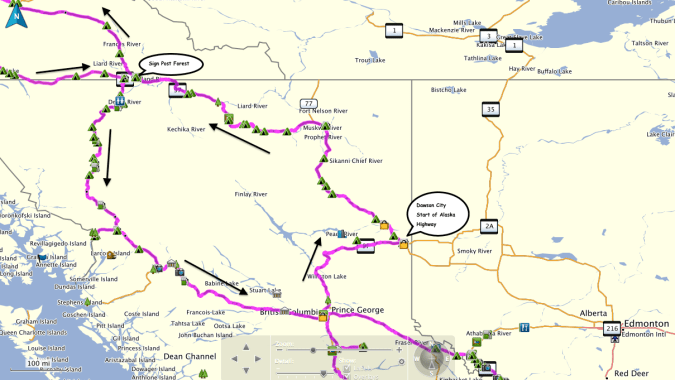
It will involve a drive from Vancouver, WA to Dawson City, Yukon Territories, Canada, up the Dawson highway to the Arctic Ocean at Tuktoyaktuk, YT, Canada and back. It is something I have never done and it has always been on my bucket list. I have taken 2 cruises to Alaska and have loved the experiences. I now want to experience the lands of Canada and Alaska from the ground driving through the countryside.

Map 1Map 2Map 3Map 4

  • Will it be an adventure? …..yes as this will go far north as you can drive in Canada.
  • Will it be exhilarating? …..Yes.
  • Will it be fun and exciting? …..Definitely.
  • Is this outside the box for travels…..Definitely.
  • Am I excited to plan and start this adventure? …..OH YES.
  • Has this route been carved in stone…..NO, it will change even as we travel I’m sure.

The trip will leave Vancouver, WA and head up Interstate 5 to the Canadian Border. Crossing into British Columbia, Canada the journey continues north to Prince George, BC and to the start of the Alaskan Highway in Dawson Creek, B.C., Canada. British Columbia has a population of approximately 4,751, 600 in 364,764 sq. miles (944,735 sq. km) making it the 3rd largest province in Canada.

Heading north from Dawson Creek we will go along The Alaskan Highway, Canada Highway 97, passing through Fort Nelson and entering the Yukon Territories, Canada just before Watson Lake to visit the Sign Forest. The Yukon has the smallest population of any Province/Territory of Canada at approximately 37,858 with a land area of 186,661 sq. miles (483,450 sq. km).

What is the difference between a Province and Territory? Territories are administrated differently than Provinces. Provincial government powers are laid out in the Constitution, whereas the territories are given powers from the federal government, thus the territories control less of their own affairs.

Heading north on The Campbell Highway, Canada 4 we will stop in the old mining town of Mayo / Keno then will then make our way up the Dempster Highway, Canada 5, crossing the Arctic Circle, Inuvik, Northwest Territories, Canada and then continue the final 130 km on the new all season road to Tuktoyaktuk, Northwest Territories, Canada and the Arctic Ocean. The Northwest Territories has an approximate population of 44,469 that live in an area of 452,480 sq. miles (1,171,918 sq. km), this province has about the one sixth of the land area of Canada making it the second largest and most populous territory of Canada.

I mention the population and sizes of these Territories as they are still sparsely populated; a majority of Canadians live very close to the border with the United States. The population for the state of California is estimated to be 39,497,000 in 2017 with an area of 163,696 sq. miles (423,970 sq. km). The state of Washington has approximately a population of 7,535,591 and a land area of 71,362 sq. mi (184,827 sq. km). When you look at these numbers California has 241 people per sq. mile (93 people per sq. km), Washington has 106 people per sq. mile (40 people per sq. km), while The Yukon with 6.5 people per sq. mile (1 per sq. km) and The Northwest Territories having 1 person per sq. mile (about 1 person per 2 sq. km). So as you can see the farther north we head the less people, cities and urbanization will be encounter.

SOUNDS LIKE A GOOD PLAN.

After dipping our feet into the Arctic Ocean and exploring the area it will be time to return to Dawson City, Yukon Territories, Canada to explore the old mining district and town. The journey will then cross the Yukon River on a ferry as we head west to Chicken, Alaska along Top of the World Highway. Continuing on the Taylor Highway to the junction with the Alaskan Highway, we turn south for Haines, AK along the beautiful Haines Highway.

Backtracking to the Alaska Highway the route passes through the Capitol of the Yukon Territories, Whitehorse, the only city in the Yukon Territory. Leaving Whitehorse we will head toward the Cassiar Highway, Canada 37, and back to Prince George. From Prince George it is east to Jasper, Alberta, Canada to visit Jasper National Park and Banff National Park along the Icefields Parkway to Banff, Alberta, Canada.

From Banff we will enter back in to the continental United States and journey along the Going-to-the Sun Highway in Glacier National Park. After a short stay in Glacier NP it is time for all to return to our home bases.

·      Adventure? …..I think so.

·      Something out of my ordinary routine? …..DEFINITELY for me.

So what does this involve? A lot of investigation on the Internet, reviewing maps and with the help from individuals who kindly share their knowledge of the areas that are being visited. I will be camping along the way when possible and staying at motels, hotels or lodges only as needed to freshen up.

·      Will schedules change?

·      Will additional sites present themselves?

·      Will destinations be revised?

All a YES to me, it is still being planned so anything is all possible.

Since we will be camping most of the nights along the journey. Some of the camping equipment in my vehicle will include Roof Top Tent, sleeping bag, stove, pots, fry pan, plates, cooking and eating utensils, camp chair and table, mosquito repellant and head netting, camp lights and batteries, propane, lighter and matches, trash bags, cleaning bucket, 5 gallon drinking water container, a refrigerated cooler and food storage containers, a hand held GPS, first aid kit, whistle, cordage (para-cord), knife, bear spray, maps, compass and Garmin In-Reach Satellite Emergency System . Communication between vehicles will be with HAM, GSMR and Citizen Band (CB) radios. We will have at least one complete set of tools and vehicle recovery gear for any unforeseen issues with mine having a winch permanently installed.

This should be a great Journey.

New Years trip to Washington – Part 4

The next few days were spent visiting with the family and friends I do not get to see that often. My son had made a plan and got together a few friends to go on a little adventure on New Years morning out to Tillamook State Forest about 40 miles west of Portland, OR.

This 364,000-acre (1,470 sq kilometer) forest is managed by the Oregon Department of Forestry and includes areas for campgrounds, hiking and backpacking trails, fishing, swimming, timber operations and interpretative center. There are trails for horses and pack animals, mountain bikes and motorized vehicles. This temperate rainforest averages more than100 inches (2,500mm) of rain a year and is considered one of the wettest areas of the United States.

New Years Eve we were the old folks and went to bed early as we were meeting everyone out there at 8:30 the next morning, so an early start from home was mandatory. Up at 5AM I showered (to wakeup) made a good breakfast and got my snack items and lunch for the day ready.

Arriving a little early we got a meeting spot at Browns Camp and were amazed at the number of people with the same idea. The staging area was filling up fast. Finally the last straggler pulled in, we organized everyone to communications, the general route and off we went with my son leading the way.


Heading up Firebreak Trail from the staging area and into the State Forest was great, the further back in we went the less people we encountered.

Finishing this short trail we head along Power-line Trail and we swing back onto forest service roads at University Falls to make our somewhat meandering way south to……


…..the fun Cedar Tree Trail where we drive under a fallen cedar tree, you don’t get to do that to often.

Back onto Forest service roads we meander north back to Browns Camp for a rest stop before our drive back home.


What a great way to start off the new year meeting new people, traveling this adventure with 10 other family filled vehicles and being out in the forest on a brisk but beautiful day. The 18 mile tail run was so much fun. Getting back home in the late afternoon we had dinner and relaxed for the night discussing what other adventures we should have in the next few days.

A short trip exploring desert mines

Location

As a trip I have taken on my motorcycle before I wished to explore the El Paso Mountain area at a slower pace and take my larger camera with me. This happened a few weeks ago and I had such a fun time exploring I will return again as there are so many additional sights that I could not visit in one day.


The trails took me from Red Rock Canyon State Park through the El Paso Mountains finally exiting close to the old gold mining town of Garlock. This west to east trail can be traveled in either direction and has many side trails leading to other areas.

Continue reading