Day 7 – Up the Dempster to the Arctic Ocean and Tuktoyaktuk

From the junction of the Klondike and Dempster Highways, it’s 456 miles (734 km) to Inuvik, North West Territories and then an additional 86 miles (138 km) north to Tuktoyaktuk, North West Territories beside the Arctic Ocean.

The Dempster Highway is only paved for the first 5 miles (8 km) from the Klondike Highway and the last 6 miles (10 km) into Inuvik. The road is open year round but it is a hard road on vehicles and tires, its gravel surface has sudden changes, potholes, becomes boggy and slick in wet weather and is made of crushed shale, which is very damaging to tires. You will need to use 2 free ferries on your drive to Inuvik. Calcium Chloride is used to stabilize the road during wet conditions so it’s advisable to clean the vehicle as soon as you can after traversing this road.

Woke up the next morning and there was a light rain falling. It lasted for a few hours in the morning then cleared up.

Making our way up the Dempster we pass Engineer Creek Yukon Government Campground at mile 120 (193.8 k) where it was decided a short break was needed. We drive around the loop of campsites to explore the possibility of this being a stop on the way south. It was fortunate that we went through as I noticed a gentleman’s vehicle I knew from Instagram that was also making the trip north. He had already been to Tuktoyaktuk and was making his way south. Stopped for about 30 minutes exchanging tales of our adventures so far. The campground is full and very quiet although quite soggy from the rain and has many mosquitoes swarming about, no doubt from the rain. This was an area with he most mosquitoes experienced on the trip.

You must go all the way to Eagle Plains for gas, food, and lodging. This small outpost is located 229 miles (369 k) form the the gas station at the intersection with the Klondike Highway. Remember to fill up with gas when available along the Dempster, there might be long distances between services.

At 252 miles (405.5 km) from the Junction with the Klondike Highway you arrive at the Arctic Circle.

At 289 miles (465 km) you pass into the Northwest Territories. This Territory has approximately 519,734 sq mi (1,346,106 km2 ) with a population of only 44,420 residents (estimate for 2019).

Just a short distance takes you to the first ferry crossing at the Peel River. We are the only vehicles on this northern crossing of the ferry.

Video by H. Berge

Video by H. Berge

One mile past the ferry crossing we arrive at our camp for the night, Nitainlai Interpretive Center and Territorial Park Campground. The center has very nice exhibits and displays of the Gwich’in culture. The adjacent campground has water, firewood, toilets and wonderful warm showers. It is a nice respite after a days driving.

7-27-25

Before settling down for the evening gasoline is required in the vehicles and as tomorrow is Sunday the stations won’t be open till about noon. It is a short drive north into Fort McPherson, a town of a population of approximately 791 people with a Café, 2 grocery stores, 2 gas/diesel stations and an 8-room hotel 342 miles (465 k) along the highway.


Day 6 – Campbell Highway, Klondike Highway and onto the Dempster.

After an easy breakfast we left camp about 8:30 to continue along Canada Highway 4, The Campbell Highway following old fur trade routes. This 362-mile (5983 km) paved but mostly gravel road will lead to Highway 2, the Klondike Highway,  for the adventure to the far reaches of the Northwest Territories and the Arctic Ocean along the Dempster Highway.

The highway is named after the first white man to explore the Yukon area, John Campbell, this all season road leads from Watson Lake to just north of Carmacks on Klondike Highway (2). This rougher road is shorter in distance than continuing along to the junction of the Alaskan Highway and the Klondike Highway but it is much slower. Services are few and far between along this highway.

Stopping at several overlooks of the Yukon River we noticed several small dots moving along the river. Canoeists were floating and paddling with the current, their boats loaded down with camping gear. Now that looks like a great adventure to make (another bucket list item).

We are now in a landmass named Beringia stretching from eastern Siberia, through Alaska, and to the Yukon. This area was not covered in glaciers at the time of the Ice Age but was an area of dry, dusty, treeless Steppe where you could see Bison, wild ponies, Wooly Mammoths among other animals. During the ice age the water level dropped 425 feet (130 m) creating Beringia, the land bridge between Russia and North America.

Making it to the the Klondike Highway I stopped at a scenic overlook and made lunch. What a delightful place to eat.

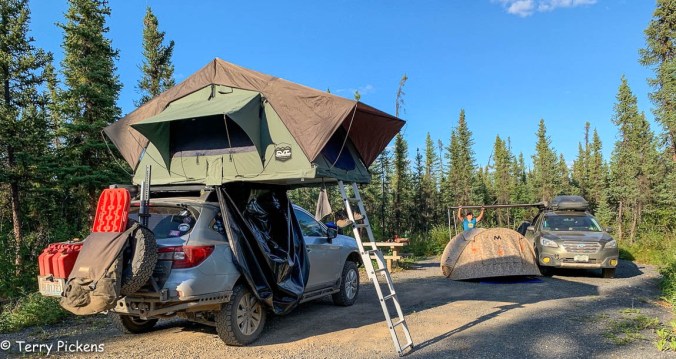
It was decided early that this day would be another drive day to make it to the Dempster Highway quickly as a storm was moving into the area. Wanting good weather in Tuktoyaktuk we pressed on making it to the start of the Dempster at about 4:30 in the afternoon. Filling with gas at the intersection we continued about 70 miles to stop and camp at the end of a emergency airstrip. Pulling far off the end of the runway and completely off the marked airstrip we set up camp at 7:00.

Day 5 – Into the Yukon Territories

Leaving the Northern Rockies Lodge we continuing traveling on the Alaska Highway heading toward the Yukon Territory.


Lower Liard Bridge built in 1943 is a 1,143-foot (348 m) long suspension bridge is the last remaining suspension bridge along the Highway.

Liard River Hot Springs Provincial Park is a day use area with some camping. A short hike leads back into the Hot Springs Pool and has been a favorite stop along the highway to soak away those long days of driving. Passing through Liard River Hot Springs there are buffalo all over the road. It was like I was transported to Yellowstone National Park where I was stuck in a Buffalo traffic jamb. The buffalo here stuck to the shoulder of the road not creating a problem for traffic.


The Alaska Highway travels east and west for a portion of the route today so you pass into and back out of the Yukon Territory for a few miles until you enter it for good about the 7.5 miles (12 k) before the town of Watson Lake.


Next stop was Watson Lake, a town 612 miles (980 km) along the Alaska Highway is best known for the few acres of the offbeat at the Sign Post Forest. Designated in 2013 as a Yukon Historic Site, was started by Carl Lindley by adding a sign at this location pointing to his hometown with the mileage. Other G.I.’s added more signs to the post for their hometowns. started this collection of signs and license plates from all over the world during the construction of the AL-CAN. Numbering about over 80,000 signs travelers are still adding to this collection. Right behind is the Alaska Highway Interpretive Center, which has a video on Yukon history with photos and displays of the construction of the AL-CAN. This was town was important during the construction due to the airport and being one of the major refueling stops of the Northwest Staging Route.


Turning north along Canada Highway 4, The Campbell Highway, a 362-mile (5983 km) paved but mostly gravel road will lead to Highway 2.


Named after the first white man to explore the Yukon area, John Campbell, this all season road leads from Watson Lake to just north of Carmacks on Klondike Highway (2). This rougher road is shorter in mileage than continuing along to the junction of the Alaskan Highway and the Klondike Highway but it is much slower. Services are few and far between along this highway.

At Ross River, a supply and communications base for prospectors in the area that is now a jumping off point for hunters and canoeists, it was decided to stopper the evening at Lapie River Campground. Setting ups camp we took the short walk down too the river to enjoy the sounds.


Day 4 – Onward to Fort Nelson and Beyond

Waking up the next morning there was a light rain dropping on the tent. Packing up quickly and having a quick breakfast we cross the Kiskatinaw Bridge and link back up with the Alaska Highway a little further north from where we left it last night.

Here are some sights that are located along the drive today. Medium to heavy rain meant we continued on praying that it would stop for the evening camping.

H. Maclean Rotary RV Park at Charlie Lake has a memorial for 12 soldiers that drowned in May of 1942 when their pontoon boat sank transporting equipment to the job site on the opposite bank of the river.

The treacherous Suicide Hill was a grade that welcomed travelers with a signpost reading “PREPARE TO MEET THY MAKER”. Guess you had to have a sense of humor if you were traveling up here in the early years. The Highway now bypasses this hill.

330ed5e06ffb22bde3e0e74dc0f2d42b--us-army-soldier-alaska-highway

Suicide Hill

Sikanni Chief River Bridge was the first permanent structure completed along the highway. Built by African American army engineers it was destroyed by an arson fire in 1992. Only the original pilings are remaining.

The southern end of the Trutch Mountain Bypass is at Historic Milepost 191. This section of the Highway was bypassed in 1987 with a new road eliminating a steep mountainous winding drive. The original roadbed is a gravel road still in use by gas and oil patch crews.

Fort Nelson 283 miles (454.3 km) north of Dawson Creek is another town offering lodging, services, campgrounds and a few attractions. Originally based on the fur trade, the town was built in 1865 along the Fort Nelson River’s west bank after the second town was destroyed by fire after the local aboriginals killed the 8 inhabitants in 1813. A upward growing population in the 1940’s and 1950’s got the town recognized as an Improvement District in 1957 and finally a village status in 1987. Mile zero to clearing crews of the AL-CAN, this town is where the first clearing crews started work along the AL-CAN as a winter road already existed between Dawson Creek and Fort Nelson.

Arriving in Fort Nelson it was still raining pretty good so went into the Visitor Center for a break from the drive and to discuss the plans for the night. This is a very nice Visitor Center with a great information desk, a souvenir shop, visitor information brochures, a short movie on the area and a large sitting area for resting. Going onto WiFi it was shown by weather apps that the rain will not subside anytime soon and is scheduled to be pretty heavy at times.

Searching the road ahead it was determined to try and get a place to stay along Muncho Lake at The Northern Rockies Lodge. This is a nice lodge but a little expensive. Oh well, this might be the last time for a room and shower for awhile and the rain was coming down pretty good.

Asking the information desk on a nice place to have a late lunch it was recommended to try a restaurant just down the street. The Gourmet Girl is a small establishment that serves very good food in a quaint atmosphere.

Veering west for 200 miles (322 km) the Highway enters a dense forested area with distant wilderness vistas of 100 miles (161 km) or more.

Gardner Creek is named for local trapper Archie Gardner who helped recon this part of the AL-CAN. He is remembered in Earl Browns book “Alcan Trailblazers” by Harry Spiegal as “An old trapper….who has lived up here all his life, is the wrangler and is in charge of the string. He wears homemade moose-hide beaded moccasins; Kentucky-jean pants [and] a big beaten slouch hat. A hank of grey hair protrudes from his old hat and half covers his eyes. He sports a half growth of stubby grey whiskers and smokes a crooked, big bowl, sweet smelling pipe…..Archie is 62 years old and even though quite thin and weather beaten, he is as straight as a spruce tree and as nimble as a boy in his teens…..Archie knows this country like a book and I’m sure his knowledge of this terrain is going to be very helpful for our work.”

A required stop along the Highway is Testa River Lodge, Services and Campground for some world famous cinnamon buns. This is a very nice location with small souvenir shop, campground with showers and laundry, and a nice outside covered sitting area to rest.

At Historic Milepost 392 is the highest pass on the highway at 4,250-feet (1,295 m).

Another reroute of the original Highway is at Muncho Lake. The original highway is far above the lake on the mountaintop and required considerable excavation by the crews. It was relocated to a benched terrace right above the lake; hikers and mountain bikers now use the original road.

7-24 Rainy Day-1

Arriving at the nights destination, Northern Rockies Lodge, it is a lovely place. This historic highway lodge is open year round providing accommodations, a full service restaurant, gas, seasonal camping and a flying service.

Day 2 – Onward toward Dawson Creek and the Alaskan Highway

After waking up and eating a good breakfast we continue north on Canada Hwy 97 and take a side loop road to Chasm Ecological Reserve. This canyon was carved by a stream 10,000 years ago at the close of the Ice Age. You can see the layers of lava in the walls of the chasm.

Along this section of Highway there are Mile Houses. These were so named because they are located that many miles from Lillooet (Mile 0) of the Cariboo Wagon Road. As the gold rush subsided, ranchers began to settle the surrounding areas and the towns held onto those names.

At the town of 100 Mile House, the worlds largest pair of cross country skis, as stated by the plaque in front, stand in front of the Visitors Center. 100 Mile House’s origins as a settlement go back to when Thomas Miller owned a collection of buildings serving as a resting point for the traffic of gold seekers moving north to the gold fields.  It acquired its name during the Cariboo Gold Rush when a roadhouse was constructed in 1862 at the 100 mile (160 km) mark up the Cariboo Wagon Road from Lillooet.

Giant Skis

And the first revision to the trip, it was decided to not stop at Barkerville and continue north. Barkerville shall be saved for a future adventure.

After passing through the large town of Prince George it was time to visit another site just off the highway, The Huble Homestead Historical Park.

Getting there right before to closing we had about a 1/2 hour to hurriedly walk through the Farmhouse, and Barn before looking around at the farm equipment in the fields surrounding the homestead. The farmhouse is a typical Ontario Farmhouse that took nearly a year to complete. Mr Huble later relocated and connected the old smaller family cabin to the side of the house to be used as summer kitchen. The house consists of a parlor, dining room, an office, a first floor master bedroom, and four upstairs bedrooms.

A barn, equipment shed and several small individual workers cabins surround the homestead.

Al Huble and Edward Seebach partnered to set up a business selling goods to trappers in the area and people passing through. After 10 years the business became so successful they built a false front General Store facing the river, painting it white to draw attention to it. This building, relocated closer to the Homestead Historical Park, served local land owners, travelers on the Fraser River and construction crews for the new Grand Trunk Pacific Railroad.

Homestead 12

Continuing the northward trek, the nights campsite was at Crooked River Provincial Park along side Bear Lake. After setting up camp and having a quick bite to eat it was time for a stroll down along the lake shore to again be witness to a beautiful sunset.

Day 1 – The first push from Vancouver, WA

Planning this adventure has been a 2 year ambition of mine. Last year life got in the way of the trip so this year it was a go. I got some interest from a few people that would like to tag along and one did show up at my house the day before departure.

Leaving early to get through the Sunday morning Seattle traffic the first stop will be the border crossing into Canada. After an easy crossing at the border we headed toward Abbotsford, British Columbia  going north on BC 11 to Canadian Hwy 1.

The first section of the journey follows Canada Hwy 1 and the Frasier River. A 20-mile section of this road also includes 7 tunnels you must pass through.

Stopping at Hells Gate we elect to walk the 35 minutes down into the canyon instead of taking the Aerial Tram (Gondola). This abrupt narrowing of the river is located just downstream of Boston Bar. The rock walls of the river plunge toward each other forcing the waters through a passage only 35 meters (115 ft) wide.

The narrow passage has been a fishing ground for Local Native communities in the area for centuries. European settlers began to congregate there in the summer months to fish. This canyon became a route used by fortune seekers of Gold Rush miners accessing the upper Fraser gold-bearing bars and the upper country beyond. It was a dangerous passage where canoes didn’t dare its rapids. Ladders and shelf roads were constructed to get around its treacherous waters. Only one Sternwheeler successfully manuvered through this section of the canyon.

Continuing on Canadian 1 for a short time we decided to stop at Goldpan Provincial Park for the night. Finding a campsite along the river makes for an ideal location for the nights camp. After eating dinner it’s a short walk to the water to sit on the back with feet in the cool water and watch the sun set behind the mountain.

And this is what was heard in the tents all night long, what a sweet background noise to lull you into slumber.

Canada / Alaska Adventure in July-August

All right my trip is getting closer and I’m in the final stages of preparation. Vehicle is ready just needs final fluid changes before leaving. Camping gear is waiting. GPS route is set and just the final tweaks and additions are being done.

2018 Tillamook

Will be leaving Southern California on July 9th heading to Vancouver, WA along Highway 395 for the birth of my 4th grandchild. Leaving Vancouver I will head to Glacier National Park, Banff and Jasper National Parks in Canada then start the northern push to Dawson Creek, B.C. and start the drive there at Mile-marker Zero on the Alaskan Highway (Al-Can to us older folks) to Watson Lake, Yukon.

Turning off the Alaskan Highway at Watson Lake I’ll be on Canadian 4, a gravel road, to make my swing to Dawson, Yukon and the Arctic ocean at Tuktoyaktuk, Northwest Territories. At this, my furthest point north, I start my swing back to Dawson and turn west to continue along the Top of the World Highway to Tok, Alaska.

Leaving Tok I will go south on the Alaskan Highway to Haines Junction and continue to Haines, Alaska along the Haines Highway to ferry across to Skagway and head back to the Alaskan Highway along the South Klondike Highway. I will leave the Alaskan Highway just before Watson Lake and turn south onto Canadian 37, The Cassier Highway, to Prince George, BC. From there I will continue south along Canadian 97 making my way back to the border and return to Vancouver, WA to visit my new grandchild before returning home south along Highway 101.

I have found during research a great resource for the area called, “The Milepost”. this details the Alaskan Highway and side-routes in Alaska, British Columbia, the Yukona nd Northwest Territories. I also picked up a camping guide named “Traveler’s Guide to Alaskan Camping” that includes all the Alaskan Highway and the same side-routes in it’s pages. Although this book was written for RV’s in mind it is good source for me, tent camping, to hit some campgrounds with services such as WIFI, showers, and laundry facilities along the way. It ranges from private, to Provincial Parks, to free camping areas along the roads.

milepost-book.jpg


Canada PLANNING PART 2 – Onward to Jasper and Dawson, Yukon, Canada

Lets go on an Adventure

ADVENTURE – An exciting, daring, bold, risky or very unusual experience or undertaking fraught with physical, financial or psychological risks.
Any ideas of what to visit in the areas I am traveling would be appreciated, not all sites are noted somewhere, secret spots abound. And if you share these secret spots with me to enjoy I will not post where they are but will relish in the beauty around me and be grateful you trust me with this shared this information.

Continue reading

The Canada adventure is in planning

ADVENTURE – An exciting, daring, bold, risky or very unusual experience or undertaking fraught with physical, financial or psychological risks.

Lets go on an Adventure

What does this mean? It can be different for everyone; skydiving, mountain climbing, scuba diving, river rafting, caving (spelunking) traveling, exploring…… anything that is outside the ordinary for that individual is an adventure. Many make their adventures a way of life and never stop. For some it is just a day, weekend or short trip. Does it need to involve speed, height, a high level of physical exertion or highly specialized gear, some would say yes. I do not think that at all, it is up to the individual the extent of the adventure to be accomplished.

Next August my ADVENTURE will involve a 45 drive from Southern California to Dawson, Yukon Territories in Canada, up the Dawson highway to the Arctic Ocean and back in my 2017 Subaru Outback. It is something I have never done and it has always been on my bucket list. I have taken 2 cruises to Alaska and have loved the experiences. I now want to experience the lands of Canada and Alaska from the ground driving through the countryside.

2017-10-31 OverallMap

·      Will it be scary? …..Probably as I will be doing it alone.

·      Will it be exhilarating? …..Yes.

·      Will it be fun and exciting? …..Definitely.

·      Am I excited to plan and start this adventure? …..OH YES.

The trip will leave Southern California and head up east side of the Sierra Nevada Mountains then I will cut over to Vancouver, WA to visit my son and his family for a few days.

2017-10-31 CA2Van

The Adventure really begins after this visit as I head to Glacier National Park, Montana; Waterton Lakes National Park in Canada. Continuing north to Banff and Jasper National Parks, Alberta, Canada. Then going north into the Yukon Territory, the smallest and least populated province in Canada to the small town of Dawson. From Dawson I will head up the Dawson Highway to Inuvik, Northwest Territories, Canada and then continue the final 130 km on the new all season road to Tukoyakuk, Northwest Territories, Canada. Returning to Dawson I will then head east to Chicken, Alaska turning south for Haines to cross on the ferry to Skagway, Alaska. It will then be time to head south after a few days rest in Skagway. Stopping again in Vancouver, WA I will hopefully finish with a camping trip in the Sierras with a group of Overland Bound friends to end this adventure. That is the rough itinerary at this time.

·      Adventure? …..I think so.

·      Something out of my ordinary routine? …..DEFINITELY for me.

So what does this involve? A lot of investigation on the Internet, reviewing maps and with the help from individuals who kindly share their knowledge of the areas I am visiting. I will be camping along the way when possible and staying at motels, hotels or lodges as needed. Road conditions, places to stay, services (food and gas), places to visit all need to be investigated.

·      Will schedules change?

·      Will additional sites present themselves?

·      Will destinations be revised?

All a YES to me, it is still being planned so anything is all possible.

My vehicle is still getting prepared for the adventure with items to makes it’s life and mine more enjoyable. Better suspension, all-terrain tires, roof rack, navigation equipment, full size spare tire, tow strap, tools, tire gauge, tire repair (plug) kit, gloves, fire extinguisher, shovel, axe, extra gas can, repair parts, extra power outlets added for charging all the electronic gear that we all carry now, tint for the rear windows, communications, boost jump starter battery charger and jumper cables, and a portable air compressor for a start.

w: Springs 1

My clothing and toiletries will be my normal travel items (see previous post) modified for the weather. I will possibly be adding a Go Pro video camera to my photographic equipment for additional documentation of the adventure.

Then I must go through the camping gear to pare down to the basics on what I really need to take along. It will include tent, tent ground cloth (footprint), sleeping bag and pad, stove, pots, fry pan, plates, cooking and eating utensils, dishpan, dish soap (Dawn), camp chair and table, tarp, mosquito repellant and head netting, camp lights and batteries, propane, lighter and matches, trash bags, cleaning bucket, 5 gallon drinking water container, a cooler and food storage containers.

Additional gear will include a hand held GPS, first aid kit, whistle, cordage (para-cord), knife, bear spray, maps, compass and possibly a small backpacking hammock.

Now what am I visiting along the way.

Part 1

The real start of my trip will be when I leave Vancouver, WA for Glacier National Park in Montana where I will be overnighting at the Apgar, Sprague Creek or Fish Creek Campgrounds depending on availability in the south end of the park.


From there I will head over “Going to the Sun Highway” to see the sights and stop as needed for the night.

2017-10-31 Glacier

The next day I will enter Canada and stop for a few days to explore the area of and around Waterton Lakes National Park.

After Waterton, I will head to Banff to stay for about 5-6 days in a condo (timeshare exchange) to explore the surrounding area. Along the way to Banff I will stop at the Bar U Ranch National Historic Site to look around.

2017-10-31 Glacier2Jasper

The fist day I will wander around the town of Banff getting current information at the Visitor Center and the Banff Park Museum, visit the Whyte Art Museum of the Canadian Rockies, the Natural History Museum and the Buffalo Nations Museum. Just outside of town I will visit Cave and Basin National Historic Site and the Upper Hot Springs.

In my remaining days in Banff I will explore up Highways 1 and 1A as far as Lake Louise visiting locations and scenic overlooks such as Backswamp, Muleshoe, Sawback, Hillsdale Meadows, Johnson Canyon, Moose Meadows, Silver City, Rock Lake, Castle Cliffs, Storm Mountain, Castle Lookout, Protection Mountain, Baer Creek, Outlet Creek, Corral Creek, Lake Louise and Moraine Lake. Returning at the end of the each days adventure to sleep in a nice bed with kitchen area. If the condo idea falls through I will just head north along those highways stopping at campgrounds along the way to Jasper, Alberta, Canada.

2017-10-31 Banff2LL

Now, how have I found this information? From maps; computer mapping programs; books, searching the specific areas I wish to visit on the Internet (Google is my friend); country, territory and city visitor information sites; and information from other travel bloggers. I have gone to my local bookstore to wander and peruse the shelves looking for interesting travel books of these areas. I will go to my local Automobile Association to find out what information they might have available there. A travel book, map and your time searching are well spent in preparing for a trip. Information gained ahead of the trip will help insure you plan the time to see the sites most important to you.

I will continue with the planning of this adventure in additional posts so please stay tuned.

Any ideas of what to visit in the areas I am traveling would be appreciated, not all sites are noted somewhere, secret spots abound. And if you share these secret spots with me to enjoy I will not post where they are but will relish in the beauty around me and be grateful you trust me with this information.