Day 3 – To Dawson Creek

It was a short drive to Dawson Creek, B.C. from the campsite.

Along this section of Highway 97 is the Town of Chetwynd with its chainsaw carving project that began as part of the 50th anniversary of the construction of the Alaska (Alcan) highway. Located along the main roadway and at the Visitor Center these carved chainsaw statues are something to admire and are exquisite as you pass through.

Chetwynd_from Google

The Alaskan Highway formally starts in Dawson Creek, BC at Mile Marker 0. The 1,422-mile (2,288.5 km) long formal Alaskan Highway ends in Delta Junction, AK while the unofficial end is in Fairbanks, AK, 1,523 miles (2,451 km) from Dawson Creek, BC.

Alaska-Highway-Map

Dawson Creek was incorporated as a city in 1958 and is a principal railhead of the British Columbia Railway and the intersection of 4 major highways in the area. Make sure to get your photo at Milepost 0 Cairn, visit the Pioneer Village, Dawson Creek Art Gallery and the Alaska Highway House to name a few of the sites in town. And if you have time visit the Northern Alberta Railways Park.

We saw the Mile Zero Cairn / Sign Post for a photo op, the Surveyor Statue, visited the Alaska Highway House Museum, walked the couple of blocks to see the Official Zero-mile Post a few blocks away and had a nice lunch at Hug a Mug’s Coffee House and Eatery.

It is sad the original, official mile post mark was a part of countless pranks and kidnappings with this new one replacing it in the 1980’s.

ACX-ACP90184 - © - Ron Erwin

Driving 20 minutes north of town, the stop for the night was at the Kiskatinaw Provincial Park. This campsite is located right next to the curved, wooden Historic Kiskatinaw Bridge. Kiskatinaw means “cutback” in Cree. Constructed in 1942-43 by the US Public Roads Administration it replaced an original 3 span timber trestle. With a 9 degree curve to accommodate the Steep grade change and the need to notch a cliff at the east end. It was one of 133 permanent bridges built to replace the temporary bridges built by the U.S Army. At about 122m (400 foot) long it was the first curved bridge to be constructed in Canada and one of the last in North America to remain.


Day 2 – Onward toward Dawson Creek and the Alaskan Highway

After waking up and eating a good breakfast we continue north on Canada Hwy 97 and take a side loop road to Chasm Ecological Reserve. This canyon was carved by a stream 10,000 years ago at the close of the Ice Age. You can see the layers of lava in the walls of the chasm.

Along this section of Highway there are Mile Houses. These were so named because they are located that many miles from Lillooet (Mile 0) of the Cariboo Wagon Road. As the gold rush subsided, ranchers began to settle the surrounding areas and the towns held onto those names.

At the town of 100 Mile House, the worlds largest pair of cross country skis, as stated by the plaque in front, stand in front of the Visitors Center. 100 Mile House’s origins as a settlement go back to when Thomas Miller owned a collection of buildings serving as a resting point for the traffic of gold seekers moving north to the gold fields.  It acquired its name during the Cariboo Gold Rush when a roadhouse was constructed in 1862 at the 100 mile (160 km) mark up the Cariboo Wagon Road from Lillooet.

Giant Skis

And the first revision to the trip, it was decided to not stop at Barkerville and continue north. Barkerville shall be saved for a future adventure.

After passing through the large town of Prince George it was time to visit another site just off the highway, The Huble Homestead Historical Park.

Getting there right before to closing we had about a 1/2 hour to hurriedly walk through the Farmhouse, and Barn before looking around at the farm equipment in the fields surrounding the homestead. The farmhouse is a typical Ontario Farmhouse that took nearly a year to complete. Mr Huble later relocated and connected the old smaller family cabin to the side of the house to be used as summer kitchen. The house consists of a parlor, dining room, an office, a first floor master bedroom, and four upstairs bedrooms.

A barn, equipment shed and several small individual workers cabins surround the homestead.

Al Huble and Edward Seebach partnered to set up a business selling goods to trappers in the area and people passing through. After 10 years the business became so successful they built a false front General Store facing the river, painting it white to draw attention to it. This building, relocated closer to the Homestead Historical Park, served local land owners, travelers on the Fraser River and construction crews for the new Grand Trunk Pacific Railroad.

Homestead 12

Continuing the northward trek, the nights campsite was at Crooked River Provincial Park along side Bear Lake. After setting up camp and having a quick bite to eat it was time for a stroll down along the lake shore to again be witness to a beautiful sunset.

The Northern Adventure – Journey to the Yukon

Having already started the first post of this adventure HERE although I should explain what this Journey is about and where in shall go. 

But First:

ADVENTURE – An exciting, daring, bold, risky or very unusual experience or undertaking fraught with physical, financial or psychological risks.
Lets go on an Adventure

What does this mean? It can be different for everyone; skydiving, mountain climbing, scuba diving, river rafting, caving (spelunking) traveling, exploring…… anything that is outside the ordinary for that individual is an adventure. Many make their adventures a way of life and never stop. For some it is just a day, weekend or short trip. Does it need to involve speed, height, a high level of physical exertion or highly specialized gear, some would say yes. I do not think that at all, it is up to the individual the extent of the adventure to be accomplished.

The Individuals:

The explores will consist of 2 individuals who are basically strangers, we came together on social media in our interests for the outside and vehicle exploration. Communicating through the computer is all we done as we live in different states. The team consists of Heather’s 2015 Subaru Outback (#heidi_roo), and myself in a 2017 Subaru Outback (#sled_rider).


The Journey:

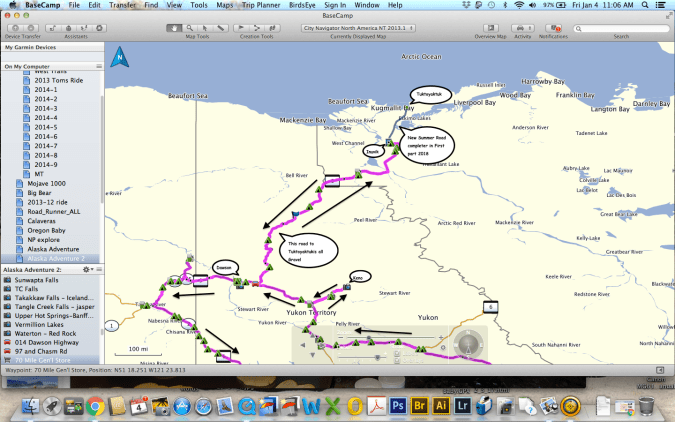
It will involve a drive from Vancouver, WA to Dawson City, Yukon Territories, Canada, up the Dawson highway to the Arctic Ocean at Tuktoyaktuk, YT, Canada and back. It is something I have never done and it has always been on my bucket list. I have taken 2 cruises to Alaska and have loved the experiences. I now want to experience the lands of Canada and Alaska from the ground driving through the countryside.

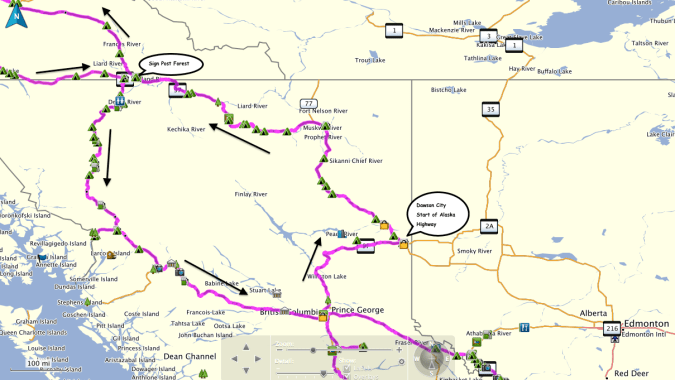
Map 1Map 2Map 3Map 4

  • Will it be an adventure? …..yes as this will go far north as you can drive in Canada.
  • Will it be exhilarating? …..Yes.
  • Will it be fun and exciting? …..Definitely.
  • Is this outside the box for travels…..Definitely.
  • Am I excited to plan and start this adventure? …..OH YES.
  • Has this route been carved in stone…..NO, it will change even as we travel I’m sure.

The trip will leave Vancouver, WA and head up Interstate 5 to the Canadian Border. Crossing into British Columbia, Canada the journey continues north to Prince George, BC and to the start of the Alaskan Highway in Dawson Creek, B.C., Canada. British Columbia has a population of approximately 4,751, 600 in 364,764 sq. miles (944,735 sq. km) making it the 3rd largest province in Canada.

Heading north from Dawson Creek we will go along The Alaskan Highway, Canada Highway 97, passing through Fort Nelson and entering the Yukon Territories, Canada just before Watson Lake to visit the Sign Forest. The Yukon has the smallest population of any Province/Territory of Canada at approximately 37,858 with a land area of 186,661 sq. miles (483,450 sq. km).

What is the difference between a Province and Territory? Territories are administrated differently than Provinces. Provincial government powers are laid out in the Constitution, whereas the territories are given powers from the federal government, thus the territories control less of their own affairs.

Heading north on The Campbell Highway, Canada 4 we will stop in the old mining town of Mayo / Keno then will then make our way up the Dempster Highway, Canada 5, crossing the Arctic Circle, Inuvik, Northwest Territories, Canada and then continue the final 130 km on the new all season road to Tuktoyaktuk, Northwest Territories, Canada and the Arctic Ocean. The Northwest Territories has an approximate population of 44,469 that live in an area of 452,480 sq. miles (1,171,918 sq. km), this province has about the one sixth of the land area of Canada making it the second largest and most populous territory of Canada.

I mention the population and sizes of these Territories as they are still sparsely populated; a majority of Canadians live very close to the border with the United States. The population for the state of California is estimated to be 39,497,000 in 2017 with an area of 163,696 sq. miles (423,970 sq. km). The state of Washington has approximately a population of 7,535,591 and a land area of 71,362 sq. mi (184,827 sq. km). When you look at these numbers California has 241 people per sq. mile (93 people per sq. km), Washington has 106 people per sq. mile (40 people per sq. km), while The Yukon with 6.5 people per sq. mile (1 per sq. km) and The Northwest Territories having 1 person per sq. mile (about 1 person per 2 sq. km). So as you can see the farther north we head the less people, cities and urbanization will be encounter.

SOUNDS LIKE A GOOD PLAN.

After dipping our feet into the Arctic Ocean and exploring the area it will be time to return to Dawson City, Yukon Territories, Canada to explore the old mining district and town. The journey will then cross the Yukon River on a ferry as we head west to Chicken, Alaska along Top of the World Highway. Continuing on the Taylor Highway to the junction with the Alaskan Highway, we turn south for Haines, AK along the beautiful Haines Highway.

Backtracking to the Alaska Highway the route passes through the Capitol of the Yukon Territories, Whitehorse, the only city in the Yukon Territory. Leaving Whitehorse we will head toward the Cassiar Highway, Canada 37, and back to Prince George. From Prince George it is east to Jasper, Alberta, Canada to visit Jasper National Park and Banff National Park along the Icefields Parkway to Banff, Alberta, Canada.

From Banff we will enter back in to the continental United States and journey along the Going-to-the Sun Highway in Glacier National Park. After a short stay in Glacier NP it is time for all to return to our home bases.

·      Adventure? …..I think so.

·      Something out of my ordinary routine? …..DEFINITELY for me.

So what does this involve? A lot of investigation on the Internet, reviewing maps and with the help from individuals who kindly share their knowledge of the areas that are being visited. I will be camping along the way when possible and staying at motels, hotels or lodges only as needed to freshen up.

·      Will schedules change?

·      Will additional sites present themselves?

·      Will destinations be revised?

All a YES to me, it is still being planned so anything is all possible.

Since we will be camping most of the nights along the journey. Some of the camping equipment in my vehicle will include Roof Top Tent, sleeping bag, stove, pots, fry pan, plates, cooking and eating utensils, camp chair and table, mosquito repellant and head netting, camp lights and batteries, propane, lighter and matches, trash bags, cleaning bucket, 5 gallon drinking water container, a refrigerated cooler and food storage containers, a hand held GPS, first aid kit, whistle, cordage (para-cord), knife, bear spray, maps, compass and Garmin In-Reach Satellite Emergency System . Communication between vehicles will be with HAM, GSMR and Citizen Band (CB) radios. We will have at least one complete set of tools and vehicle recovery gear for any unforeseen issues with mine having a winch permanently installed.

This should be a great Journey.

Day 1 – The first push from Vancouver, WA

Planning this adventure has been a 2 year ambition of mine. Last year life got in the way of the trip so this year it was a go. I got some interest from a few people that would like to tag along and one did show up at my house the day before departure.

Leaving early to get through the Sunday morning Seattle traffic the first stop will be the border crossing into Canada. After an easy crossing at the border we headed toward Abbotsford, British Columbia  going north on BC 11 to Canadian Hwy 1.

The first section of the journey follows Canada Hwy 1 and the Frasier River. A 20-mile section of this road also includes 7 tunnels you must pass through.

Stopping at Hells Gate we elect to walk the 35 minutes down into the canyon instead of taking the Aerial Tram (Gondola). This abrupt narrowing of the river is located just downstream of Boston Bar. The rock walls of the river plunge toward each other forcing the waters through a passage only 35 meters (115 ft) wide.

The narrow passage has been a fishing ground for Local Native communities in the area for centuries. European settlers began to congregate there in the summer months to fish. This canyon became a route used by fortune seekers of Gold Rush miners accessing the upper Fraser gold-bearing bars and the upper country beyond. It was a dangerous passage where canoes didn’t dare its rapids. Ladders and shelf roads were constructed to get around its treacherous waters. Only one Sternwheeler successfully manuvered through this section of the canyon.

Continuing on Canadian 1 for a short time we decided to stop at Goldpan Provincial Park for the night. Finding a campsite along the river makes for an ideal location for the nights camp. After eating dinner it’s a short walk to the water to sit on the back with feet in the cool water and watch the sun set behind the mountain.

And this is what was heard in the tents all night long, what a sweet background noise to lull you into slumber.

A forest trail adventure to dinner at Tillamook Cheese Factory, May 4th, 2019

It was decided we will make a Cheesy Mud Run in the Tillamook State Forest to the Tillamook Cheese Factory located on the Oregon Coast for dinner and ice cream. It was a nice day, sunny warm but alas not much mud. We did find one mud hole in an old quarry the guys had to go through to get the rigs dirty.

Starting early we left Vancouver for the drive to the trail head at a staging area named Rodgers Camp. Gathering there most of us hit the last outhouse we would see until dinner and the headed out along the trail. This was to be an easy drive as this was my youngest grandsons first off-road excursion at 9 months.

Not much to write about but hope you enjoy the following photos and videos.

This slideshow requires JavaScript.

We stopped for lunch on top a nice knoll. The kids played while we got sandwiches ready and had a nice leisurely lunch as the kids ate, ran and played.

This slideshow requires JavaScript.

After lunch clean up we headed east to the coast and dinner.

This slideshow requires JavaScript.

Sorry no photos at the Cheese Factory or the food, it was late in the day and we were all so hungry we ordered and sat down and just chowed it down. I must say the burger was delicious and the pizza my 4yo grandson had looked great. The ice cream was as good as always. It is so nice that this farmers Co-Op has fresh food and cheese and ice cream made right on premisis from local cows. If you get a chance stop by tour the facility, shop for some of the best cheese and have some great food.

Beacon Rock along the Columbia River

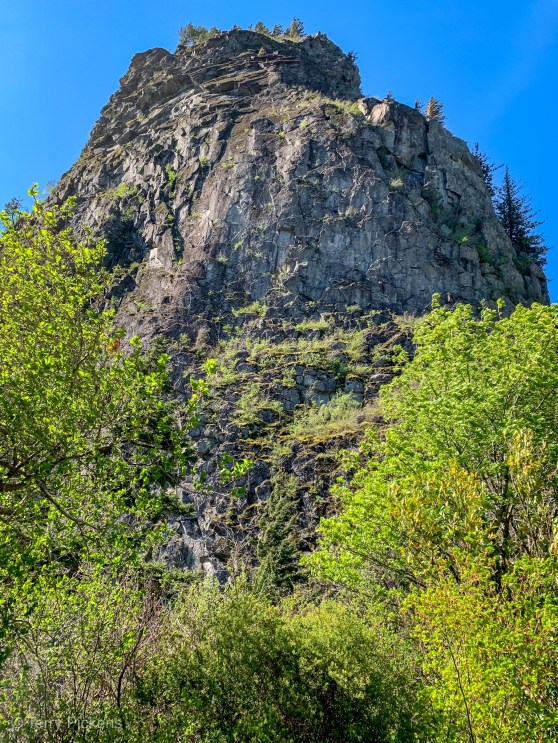
I heard of this climb in a magazine promoting hiking trails surrounding Vancouver, WA. I decided to climb the up the short 1.8 mile (2.9 k) round trip to the top of this rock when the weather got better. At only 700 foot (213 m) elevation gain this may seem like an easy hike, but don’t fool yourself it’s a 700 foot (213 m) climb in only 0.9 mile (1.45 k) involving many switchbacks, steep grades, and stairs the entire distance. Who needs a gym with a stair master when you can go out here.

IMG_0506

A prominent and distinctive geological feature along the Columbia River Gorge, this 848-foot (258.5 m) high landmark was the core of a volcano 57,000 years ago. The rock that remains is the lava core that was not washed away by the massive force of ice-age flooding. During the last Ice Age an ice dam formed in Idaho creating an enormous lake behind a 1/2 mile (804.5 m) thick block of ice.

This ice dam failed numerous times sending an enormous amount of water down through the Columbia River Gorge flowing at 60 mph (96.5 k/hr) up to 600 feet (182.9 m) deep. The city of Portland, OR could have been 400 feet (121.9 m) under water during these floods. This amount of water caused erosion created the hanging valleys and waterfalls that are prevalent along the river right now.

The trail built by Henry Biddle between 1915 and 1918 is one of the oldest trails in the area. At the time Biddle built the trail with handrails and bridges to the top for people to visit. His family later donated the land to the Washington State Parks in 1935.

An important landmark along the Columbia River this rock served as a landmark to local tribes denoting the last of the rapids of the great river. Originally named “Beaten Rock” by Lewis & Clark in their journals on the Voyage of Discovery in 1805, it was renamed on the  return journey “Beacon Rock” for unknown reasons.

This slideshow requires JavaScript.

“The entire trail is a near-continuous series of switchbacks, many of them less than 20 feet long and the trail loops over itself at least twice. I counted 52 switchbacks, while one of my sons counted 54 and the other came up with 49. That says less bad about our educational system than it does good about the distracting views. The trail is completely lined by handrails and is safe for all but the tiniest walkers.

Most of the trail is up the open, west side of the rock, providing views down the river of Angel’s Rest and Cape Horn. With little shade or water, this part of the trail can be really hot in the summertime. Beacon Rock actually has two summits and the trail works around the south one and proceeds up the east side toward the higher, north summit. The trail is forested here, but the terrain is still rocky enough to provide great views of Hamilton Mountain and the river toward Bonneville Dam. At the summit, a few quite large stairs lead to the summit pinnacle. Here, trees block a bit of the view, but it’s certainly worth seeing.

The wind is usually howling on one side of the rock and dead calm on the other side, creating a dramatic difference in the perceived temperature. You’ll need a jacket most days, but you’ll carry it a lot.” – OregonHikers.org

Morning walk around downtown Vancouver, WA

Well I’ve been very negligent in posting here for a long time. I must get back on the horse and start posting again. So here goes, I took another morning walk, this time around Fort Vancouver National Historic Site and downtown Vancouver, WA.

It started off as a foggy day at home so I decided to head down to the Columbia River to get some bridge photos of the Interstate 5 link between Portland and Vancouver. Guess I didn’t get up early enough as when I got down there and walked to the bridge the fog had lifted. Still an overcast day I decided to capture some photos of the bridge and continue my walk into downtown and find some interesting buildings to shoot.

Upon finishing in downtown I walked back to Fort Vancouver NHS and took some photos of the flowering trees that are prevalent right now here in the Pacific Northwest.

Heading home I opened the photos in Lightroom and started playing with filters and presets. Here are the results. Hope you enjoy.

Bridge at Columbia River

Downtown

The Academy was established in 1856 to meet the spiritual, social, educational and healthcare needs of this frontier region starting in a small wooden cabin near Old Fort Vancouver (Vancouver Stockade). This campus moved to it’s current location and dedicated in 1873. This site has served as a school, orphanage, religious headquarters and is still in use today as a multi-use commercial center and City landmark.

DowntownVancouver, WA-13

The Academy

Trees at Fort Vancouver NHS

My visit to Lassen Volcanic National Park on a trip south to visit family.

Lassen_Volcanic_National_Park_map

I left Vancouver for southern California and my first overnight stop was Lassen Volcanic National Park in northern California. As the name implies it’s major features are volcanic in origin. Being the southern most volcano of the Cascade Range the prominent features of the park are the largest plug volcano in the world, Lassen Peak and it’s sulfur – thermal hot springs.

7-2


Originally two separate National Monuments dedicated in 1907 by Theodore Roosevelt, Cinder Cone and Lassen Peak National Monuments were declared Lassen Volcanic National Park in 1916.

0-0

I arrived late in the afternoon after an 8 1/2 hour drive and set up camp at Manzanita Lake Campground located in the northern section of the park. Then I proceeded to walk the loop trail around Manzanita Lake, ate dinner and enjoyed a nice campfire before retiring to my tent to read and fall asleep.


Accessible by five vehicle entrances the majority of visitors enter either from the north or south along State Route 89, named the Volcanic Legacy Scenic Byway or Lassen Volcanic National Park Highway, off State route 44 in the north and 89 from the south. Three unpaved roads enter the park but do not connect with the main road through the park, Highway 89.

The north-south 29-mile (46.6k) road, Highway 89, was constructed between 1925 and 1931. The road summit is the highest in the Cascades topping at 8,512 feet (2,594 m). This road is closed in the winter months due to snow, which can reach 40 feet (12.2m) deep.

0-4

Early morning along the Lassen Volcanic National Park Highway


I got up early, had a quick breakfast and packed up to head south along Route 89 to visit the sites of the park. It was very interesting stopping at the many informative signs along the road to read the history of the park.


The last minor to major eruption started in 1914 and lasted until 1921 creating a new crater on Lassen Peak. Releasing ash and lava it fortunately did not kill anyone. This eruption covered many miles of forestlands with landslides and the new growth forest today stands many feet above the old forest floor. These landslides also created Manzanita Lake as it damned Manzanita Creek.

The first blast was on May 19, 1915 and was said to be a night to remember with it’s steam explosion and subsequent mudflows. Had it not been for Elmer Sorahan many people might have died but he ran 3 miles (4.8k) to warn others after escaping the explosion.


Three days later on May 22, 1915 another explosion on Lassen Peak threw ash, pumice, rock and gas into the air that was more devastating to the area than the first. The pressure in the mountain built up like a lid on a boiling pot of water and finally blew. You can now explore this area on a ½ mile (0.8k) loop trail or take the strenuous 2,000 foot (609.6m) 5 mile (8k) round trip hike to the top of 10,457 foot (3,187m) Lassen Peak. Many other hiking opportunities exist in the park along with backpacking, auto-touring, bird watching, camping skiing, skiing, snow play, and snowshoeing.

There are 5 hydrothermal areas to explore within the park. Sulphur Works, Bumpass Hell, Devils Kitchen, Boiling Springs Lake and Thermal Geyser. I am limiting myself to 2 for this trip.

4-4

My first hydrothermal area would have been the hike out to Bumpass Hell Hydrothermal Area, a moderate 3 mile (4.8k) round trip hike. This is the largest hydrothermal area of the park with temperatures of up to 322 degrees F (161 degrees C). I had done this hike with my kids back in the early 1990’s although I found the trail closed this season for maintenance of the trail and boardwalk through the 2018 season.

My next stop was Sulphur Works, a formation of mudpots, steam vents and boiling springs located right off the main road. This hydrothermal area in near the center of a massive composite volcano that collapsed many thousands of years ago. Mount Tehama or Brokeoff Mountain was estimated to be 1,000 feet (304m) higher than Lassen Peak. Active 400,000 to 600,000 years ago it is estimated to be nearly 11 miles (17.7k) across and had towered to 11,500 feet (3,505k).


My final stop was the Kohm Yah-mah-nee Visitor Center at the south entry of the park to visit the small museum learning the history of the park, peoples and area and had a nice talk with the Rangers.

Now for the long 8 hour drive down the east side of the Sierra Nevada Mountains along State highway 395 to the BLM area of Alabama Hills outside of Lone Pine, CA.

Fort Stevens and Ecola State Parks, Oregon

After a restful nights sleep I make a small breakfast, pack up and head out for the short 1-hour drive across the Columbia River into Oregon for a visit to Fort Stevens State Park. Located in the far northwest tip of the state this park is bordered on 1 side by the mouth of the Columbia River and on  second side by the Graveyard of the Pacific This 4,300 acre (17.4 sq km) park has much to offer to its visitors; walk or drive along the beach, hike coastal and forested paths, bicycle along bike trails, camp, beachcomb, birdwatch, visit a shipwreck, explore an abandoned military installation used during the Civil War and World War II. Or just relax and enjoy the area.

Fort Stevens Park Map

My first stop was to see one of the shipwrecks along this stretch of the Graveyard of the Pacific. Along with approximately 2,000 other ships since 1792, the remains of the Peter Iredale now rests on the sandy beach. Only a portion of this 275 foot (83.8 m) long steel ship remains, grounded where she came to rest in 1906 from a navigation error in dense fog by its Captain due to the areas treacherous weather and storms. It has become an attraction since the day it grounded on the sandbar.


Next stop was Fort Stevens. First built in 1863-64 during the Civil War it was in use up until the end of World War II, it was part of a 3-fort system at the mouth of the Columbia River to defend this waterway and ports from attack by sea. The other 2 forts were located in the state of Washington; Fort Canby at Cape Disappointment and Fort Columbia a few miles up river from Fort Canby. (For my visit to Fort Canby and Cape Disappointment see LINK)

Day 2-26

Fort Stevens installation map


During World War II a Japanese submarine fired upon Fort Stevens in June of 1942, making this fort notable as being the only military base on the Continental United States to be fired upon by an enemy since the War of 1812. 17 rounds were fired at the fort with no real damage being done.

After a full morning of exploring the buildings and small Fort Stevens Visitors Center – Museum I enjoyed a late picnic lunch and continued my journey south on Highway 101 to visit Ecola State Park. This 9 mile (14.5 k) long stretch of beach lets you enjoy hiking, picnicking, tidepooling, surfing and scenic coastal vistas. Located just north of Cannon Beach, OR I leave Highway 101 and travel the13 miles (21 k) of twisty narrow roadway into the north area of the park to see Indian Beach Day Use Area. This secluded beach is a spot frequented by surfers, beachcombers, and tidepool explorers and is reached along a short path down the hillside to the beach. Extending north is a network of trails that will provide a 2 ½ mile (4 k) loop trail to the top of Bald Mountain or continue north to Tillamook Head trailhead which is part of the Oregon Coast Trail. The loop trail is part of the Lewis and Clark National Historic Tail, walked by Lewis Clark and a band of men from the Corps of Discovery to search for a beached whale in 1806. They were hoping to return to Fort Clatsop with whale blubber as they fought hunger from their time there. They sadly return empty handed.

Day 2 Ecola State Park Map


After this beautiful day of exploring I returned to my car and drove the 2 hours back to my home to plan the next trip in a few weeks, south to visit my family and friends at the home I just moved from.

Cape Disappointment State Park, WA

Named by Captain John Meares’ 1778 disappointing sailing to find the mouth of the Columbia River for trading. Being turned away by a severe storm, he named this place Cape Disappointment. While in complete contrast Lewis and Clark’ s Corps of Discovery cheered as they completed their journey with their first sight of the Pacific Ocean on a bluff on Cape Disappointment.

“Cape Disappointment Map 07-27-16”

Cape Disappointment State Park is far from being a disappointment. Steeped in Northwest history, it is a place to explore U.S. military and maritime installations, learn more of Lewis & Clark’s Corps of Discovery Expedition and their effects on native tribes of the area. Camp, fish, hike old-growth forests, roam around freshwater lakes, saltwater marshes and ocean tidelands. Marvel at the breathtaking views from the highlands above the sea and wander the beaches that are enjoyed by kite-fliers, beachcombers, sandcastle builders and those who just love to walk. Hike to 2 lighthouses that guided the mariners to the mouth of the river and kept them from becoming victims of the Grave Yard of the Pacific.

Lewis and Clark Interpretive Center

I began my day at the Lewis and Clark Interpretive Center and one of the Battery’s of Fort Canby that defended the entrance to the Columbia River from the mid 1900’s to the end of World War II. The Interpretive center is a museum providing a history lesson of The Corps of Discovery’s journey from settled America along the Mississippi River to the Pacific Ocean. Walk along the history path in its interactive exhibits that will entertain all ages. Sitting right above Battery Harvey Allen of Fort Canby to the inland side and overlooking the Pacific Ocean from its cliff side perch it is a wonderful place to start your visit to the park.

Off to the south from the ocean-viewing platform of the Interpretive Center you see Cape Disappointment Lighthouse. Start the hike to the lighthouse in the Interpretive Center’s parking lot. You’ll walk through dense forest glimpsing ocean and river views as you make your way to the oldest operating lighthouse in the Pacific Northwest. Built in 1856 to warn the ships of the treacherous currents and obstacles of the river bar at the mouth of the river.

Continuing on driving I thought I made a very wrong turn as I saw a sign for Waikiki Beach. It is a short ¼ mile (0.4 k) walk to the beach. It was still overcast when I visited although I suspect it would be a nice place for a picnic lunch and to watch the waters and vessels of the Columbia River float past.

Continuing my exploration of the park I stopped a short time later at the trailhead to Battery 247 that is perch on a hill in a strategic location overlooking both the Pacific Ocean and the Columbia River. Very deteriorated and overgrown it is an interesting structure to wander through. Although being small I recommend bringing some type of flashlight or headlamp to go deeper into the underground ammunition building. This is also the area where Lewis and Clarks Corps of Discovery first laid eyes on the Pacific Ocean.

Following the road a little further leads me to the campground. I wish to see if I wanted to spend the night here. I found it to be a nice place right along the ocean and went back to the entry station to reserve a site for the night. I wanted a quiet spot to relax for the night so selected site #157. My site is not right along the beach, although a few are, but only 200 yards (183 m) away. In this group of 9 campsites there were only 2 other sites being occupied.


Having settled my accommodations for the night I drove up to North Head Lighthouse to walk the pathway to the base of the lighthouse. This second lighthouse was built as the Cape Disappointment Lighthouse left a section of coast unprotected from a mariner’s point of view. Built 190 feet (60 m) above sea level in 1898 this 65’ (19.8 m) tall lighthouse is still functioning and maintained by the U.S. Coast Guard. This is located on one of the windiest places along the west coast with recorded winds of up to 120 MPH (321.9 km/h).

Finished for the day I returned to set up camp and have a snack before I took a walk along the beach outside my temporary front door. The beach was an easy walk although exploring higher up the high tide line finds many logs that have been deposited along the beach during the severe storms coming in off the Pacific. Many small windbreak structures have been built by visitors add to the cozy feel of the beach.

Deciding to go back and grab my camera tripod, I return to the beach to watch the sun setting in the west. After a wonderful rest and watching a beautiful sunset I proceed back to my camp, fix a small dinner and climb into the tent early to do a little reading then to fall asleep listening to the waves crashing into the shore.

I will return here again to continue exploration of the trails in the area. The 1.5 mile (2.4 k) Coastal Forest Loop trail, Bell’s View Trail, the 1.5 mile (2.4 k) long North Head Trail and the south portion of the coastal Discovery Trail will be on the short list of walks.

I continue my journey in the morning crossing back into Oregon to visit Fort Stevens then head a little further south to see another fantastic beach.