Whether for 4 days or a month packing light means you carry the minimum amount with you on the trip, if you are not too remote remember there are places to buy things you run out of or just plain forgot. Packing light means you hand-wash your clothes nightly or hunt down self-service Laundromats every 4-5 days. And by the way I have had some wonderful conversations in self-service Laundromats all over Europe.
I’ve found one way to lighten the load as the trip progresses is to copy the maps and travel guides and throw them away as you have finished with them. If you make notes on any of your adventures just photo them for future reference. And any item that is used up just discard as completed, your back will love you at the end of a long trip.
I usually only have carry-on luggage so I tend to pack light. My larger carry-on usually weighs about 20 pounds; my smaller daypack 14 pounds due to the camera and electronic equipment.
Luggage
- Backpack or roller bag at the maximum size for carry-on (overhead compartment) depending on the trip.
- Daypack for sightseeing that fits under the plane seat area.
- Money belt.
- I use several pack-it cubes to aid in sorting

Backpack (left) roller bag (right) pick one for the trip.
Main Items
- DLSR Digital camera, 3 lenses (usually a 18-250mm telephoto,1 prime and 10-20mm), small pocket camera, small travel tripod (or monopod), extra camera batteries, multiple storage media cards, remote shutter release, and camera cleaning supplies. Find a way to backup your photo storage, it is terrible to get home and find you have lost all your photos of the trip. I am planning to get a WD 2TB My Passport External Hard Drive (not shown but it is 5”x5”x 1”) that has a media card slot for downloading the cards. My DSLR camera equipment is rather extensive as it is a hobby and passion of mine. Can I travel with just the little point and shoot, yes, and I have had fun doing it.
- Phone, Tablet.
- Battery chargers for all rechargeable devices. All electrical cords for the electronics you are carrying on the trip. Placed in 1 bag for easy retrieval and airport security.
- Backup power module (not required but nice to have).
- Small power strip for extra outlets for charging.
- Extension cord.
- Power adaptors for the country you are going to.
- Small flashlight or head lamp with fresh batteries.
- Notepads and pens. I still like the old fashioned way to keep track of anything I do during the day. Mine is 3”x5” and has waterproof paper.
- Trip itinerary, airline tickets, and information on reservations. All of these should be originals with copies in a separate location for backup. I also photograph them or PDF them on my phone so I will always have them on me.
- Guide books. Guide Books are great but there is information in them you will never need on the trip so either tear out the pages you need or just copy them and discard along the way lightening your load.
- Passport, drivers license (I always go and get an International Drivers License of travel as they are inexpensive if I am driving). Copy and PDF also.
- Credit Card with backup card and ATM card. Copy and photo. Have available the national or work wide emergency numbers if you happen to lose one.
- Map(s). Only if you’re driving or hiking. The last 2 trips driving I have used a GPS for driving and found it very useful. Maps were there just as a backup. I preplanned the route and Points of Interest at home and downloaded it into the handheld GPS unit for an easy route finding adventure.
- Phrase book(s). Learn the friendly basics and use ones in the guidebooks.
- A book to read on the plane.
- Protein bars or whatever emergency fun rations you prefer.
- Water bottle or buy a soda or water at the destination and refill it daily.
- Sewing kit and safety pins.
- List of important numbers and information. Written and in PDF form on your phone/tablet/laptop.
- 3-4 flat plastic clothes hangers.
- Zip ties.
- Elastic cord ties (come in handy for a lot of items)
- Cloths line and cloths pins.
- Large clips.
- Umbrella.
- Watch.
All electrical products you bring should be dual voltage pieces for the country you are visiting. If they are not you need to take a transformer to change the power or risk burning out the equipment.
Medications
- Any prescription or alternative medications, with prescriptions. Take a few extra days along with you, as there might be flight delays.
- Multivitamins if you regularly take them
- Imodium or equivalent for when you have to travel with diarrhea.
- Pain pills.
- Antiseptic cream
- Sun tan lotion
- Band-Aids, moleskin and one ace bandage.
- Eye Glasses prescription.
Any item below Multivitamins is not a required item and you do not need to carry a full trip supply with if you are going to an area you can replenish the supply if needed.
Toiletries
- Small bottle of liquid soap.
- Universal sink plug for washing clothes.
- Toilet paper. Keep some in your day-pack for when your out and about, you never know when the holder might be empty.
- Tissues.
- Antiseptic hand gel for when you can’t wash your hands. Keep this in your day pack also.
- Hand and face bar soap.
- Small washcloth and pack-towel.
- Tweezers and nail file (small scissors if you do checked luggage).
- Toothbrush, toothpaste and dental floss.
- Razors and shaving cream if required. I use an electric during travel and make sure it is multi-volt so I just need the adaptor
- Shampoo.
- Deodorant
- Talcum powder.
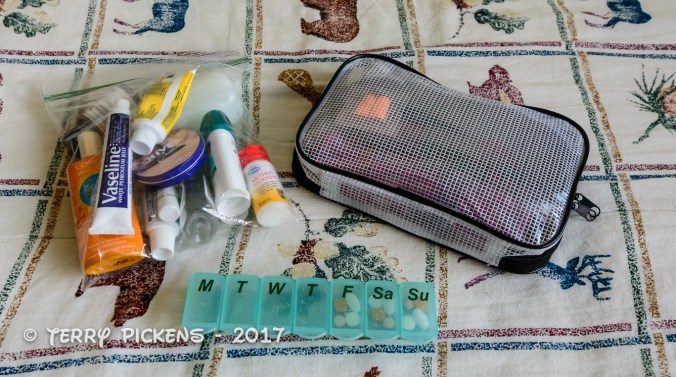
Any liquid items above need to go into a zip-lock bag sized acceptable to the security requirements if you are not checking luggage.
Clothes
- Walking shoes, sneakers with spare laces or low hiking boots if they are needed for your destination. Break them in! DO not take brand new shoes you have never worn before, after being on your feet all day you need good supportive comfortable shoes. I just take 1 pair of shoes that I can cleanup, can be used casually but also acceptable for casual dress.
- Sandals if the weather is accommodating.
- 4 pairs socks.
- 5 pairs underwear.
- 2 pair of long underwear (as required by the weather)
- 3 tee shirts for warmer days or you can layer them under your casual shirts for a bit more warmth.
- 2 pairs lightweight trousers.
- 3 long-sleeved casual shirts.
- Swimsuit. Only if you think you will be in the water.
- Fleece Jacket (water repellant and windproof)
- Water resistant jacket.
- Neck scarf. For colder days and nights.
- Hat. You preference on type or if needed.
- Gloves.
- Sleeping clothes.
This usually covers me down to about 35F.
I try to get clothes that will dry fast; you do not need to be siting waiting for items to dry and miss sight seeing. Made that mistake once, the dryers were not that hot and it took forever to dry clothes. Better if they will dry overnight after washing in the sink.
In addition to the items above I am wearing 1 pair of trousers, tee shirt, long-sleeved casual shirt, socks and underwear. I usually wear the fleece jacket onto the plane to be used to keep me warm during the flight and might have the scarf in a pocket if it will be cold at the destination.
Additional extras I might carry
- Silk sleep sack (always good to get into or just use as a throw if you are cold on the plane.
- Swiss army knife (only if you check luggage, I normally leave mine at home).
In the Money Belt on you at all times
This holds the things it would be a serious pain to replace. Place the paper contents in a zip-lock plastic bag so wet weather won’t destroy them.
- Passport
- Airline tickets/rail pass
- A letter of any special medical needs or conditions for use by a doctor or nurse.
- Credit/debit/ATM cards — at least two in case a machine eats one.
- Money, both dollars and local. Take out the maximum anount you can from ATM’s as some have a charge each time you use them. Then take half of the money and hide it separately from the rest along with the spare credit card.
- Driver’s license, if you think you might rent a car or motorbike.
- Eyeglass prescription.
- Extra passport photos for visas or travel passes bought on the road.
- Written list of important numbers.
- Trip Itinerary and reservation confirmations.
In the Large Carry-on backpack
- Clothes, shoes and jacket. If this bag is checked I try to put 1 pair of underwear, socks and a shirt in my carry-on backpack.
- Silk sleep sack.
- Battery chargers all electrical cords. Placed in zip-lock bag for easy retrieval and airport security. Unless this bag is checked then into the carry-on bag.
- Backup power module.
- Small power strip.
- Clothes hangers.
- Medications unless this bag is checked then into the carry-on bag.
- Toiletries, except liquids in a pocket that I can easily get to without undoing the entire bag.
- Small tripod or monopod.
- Swiss army knife (only if you check luggage, I normally leave my knife at home).
- Protein bars or whatever emergency fun rations you prefer.
- Sewing kit and safety pins.
- Umbrella.
- Guide books.
- Phrase Books.
In the daypack
- Cameras, 2 lenses, extra batteries and storage media cards.
- External Hard Drive.
- Tablet and phone.
- GPS.
- Notepads and pens.
- All the copies of the original papers and documents.
- Water bottle.
- Flashlight.
- Snacks for plane.
It might seem excessive to some and too light for others but I have refined this from 5 month long European trips, 5 cruises and multiple USA trips since 1999 and it is what works for me. DO I carry all of these items on every trip, NO. Might I carry more on a certain trip, YES. It must be tailored to the itinerary and the time of the trip (Season and length). All of the items that are in the large backpack fit in the roller also and both are carry-on sizes. The daypack fits under an airline seat but the is no room left under there for my feet or legs to stretch out.





 TVP Journeys
You must be logged in to post a comment.